After graduating from the L. Jeffrey Selznick School of Film Preservation at the George Eastman Museum last spring, I was honored to have been selected for the long-standing fellowship at the Rockefeller Archive Center. I was eager to apply my training and skills to aid in such a prestigious archive’s mission, and to learn as much as I could from wonderful Selznick alum Brent Phillips. As someone whose great-grandfather lived in Ossining and grandmother attended Marymount College, I was also excited to have the chance to live and work in picturesque Tarrytown for the summer!
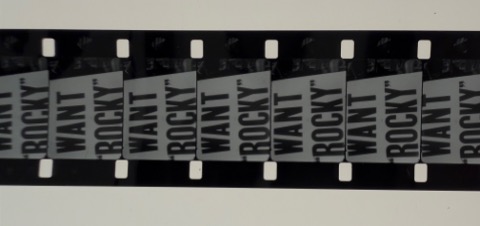 Close-up of Nelson A. Rockefeller Campaign film strip
Over the course of the ten-week fellowship, I assisted Brent with various projects, including:
- Conducting an item-level survey for over 650 phonographic records, checking for content uniqueness, rating for format obsolescence, and separating delaminating and/or moldy records.
- Inspecting films from Nelson A. Rockfeller’s gubernatorial career and adding resource records to ArchivesSpace
- Correcting inaccurate descriptive metadata on a collection of 16mm films
- Preparing video and audio cassettes for shipping to a vendor for digitization, and re-inspecting material upon returning from the vendor.
Phonographic Record Survey
The biggest undertaking of the Fellowship was a survey of 667 phonographic records in the RAC’s collections. Over 30 boxes covering 12 collections were inspected at the item level. While some recordings were commercially available vinyl discs, others were rarer formats such as aluminum or glass, several of which were printed on-demand and may be the only surviving audio of an event. Due to their age (dating back to the early 1900s) and increasing fragility, these assets remain inaccessible to researchers until digitization occurs.
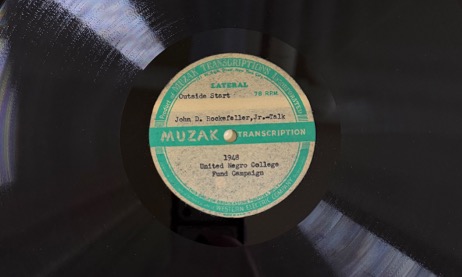 Example of vinyl disc
Every format in the RAC survey was assessed based on the Museum of Obsolete Media’s obsolescence rating system. While we intended to only examine content uniqueness, format stability, and obsolescence, upon retrieving boxes, we decided some rehousing was necessary to ensure the safety of the discs. Contents within these overpacked boxes were divided and placed into new boxes with archival spacers added to keep discs upright. Other boxes unfortunately contained broken glass discs which were removed and placed in flat protective housing. Some boxes had duplicate recordings, often in large numbers and across multiple collections which we removed and recommended for de-accessioning.
 Example of aluminum disc, 1939
The most critical issue during this survey was boxes which were found to contain delaminating and/or moldy records. Unfortunately, 43 discs (12-inch, 16-inch) were found to be undergoing plasticizer loss and/or delamination. According to the University of Illinois: “Plasticizer loss, or exudation, is identifiable as a white, greasy powder with a crystalline appearance that appears on the disc’s surface. Sometimes mistaken for mold, the powder is in fact fatty acids (palmitic or stearic) that have migrated to the disc’s surface as the plasticizers begin to deteriorate.” These delaminating discs were separated and quarantined, both to package for immediate cleaning and digitization as soon as possible, and in the case that our delamination diagnosis was incorrect, and chalky power turns out to be mold. Further testing would be required to truly determine mold vs. plasticizer loss.

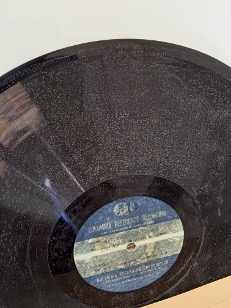 Disc showing possible delamination
The main purpose of this survey was to help the RAC understand which items should be prioritized for preservation and simplify the decision of what order preservation should occur. Several of the discs held by the RAC need to be digitized sooner rather than later, especially those known to be one-of-a-kind. The RAC may not be able to digitize these discs in the near future due to obsolescence, breakage, or delamination. I hope that the results of our survey can be used to provide crucial data for a future digitization project.
A Film History of Nelson Rockefeller’s Gubernatorial Career
Over the course of ten weeks, I inspected 40 16mm prints from a collection of Nelson Rockefeller’s gubernatorial career (1959-1973). These prints were a variety of generations and/or elements, including negatives, work prints, fine grains, tracks, and reversal. The prints also covered a variety of content, including campaign commercials, raw news footage, speeches, and press events. Due to most of these elements being from the 1960s, which is famously known for its degrading stock and poor adhesive, several prints had splices with old tape which needed to be removed and cleaned and replaced with archival tape.
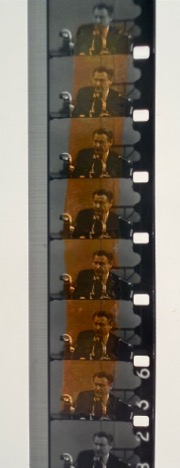

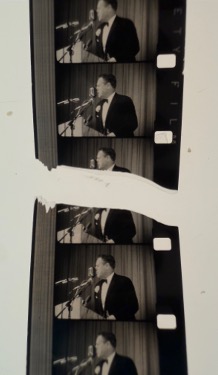
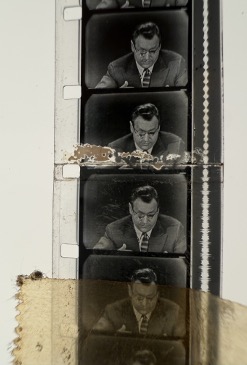 16mm prints in need of repair from the Rockefeller (Nelson A.) Gubernatorial records, Audiovisual materials
However, despite their age, I was surprised to see that most of these reels were in great condition and had minimal scratches, perforation damage, fading, or shrinkage. Many elements such as negatives looked as though they were struck and never looked at again! Each print was given a complete visual hand inspection, and new records were created and added to both the RAC’s Film Registry (primarily to capture a reel’s physical condition) and ArchivesSpace. I hope my work inspecting these prints, and the great condition I found them in, will encourage them to be digitized and composited, as many are negatives which are currently inaccessible to researchers.
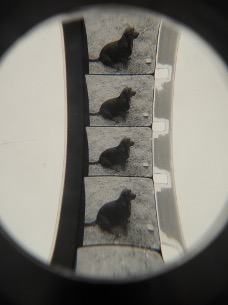 Section of a 16mm print showing a dog filmed at a county fair, 1965
Metadata Correction
During the Fellowship, a researcher contacted the RAC about incorrect descriptive metadata for a collection of films accessible on Virtual Vault, the RAC’s virtual screening room. This included incorrect runtimes, titles, scope and content notes, and color information. Brent and I pulled the original film reels from cold storage and inspected each one while also viewing the digital file in the Virtual Vault and comparing with the descriptions in ArchivesSpace and the Film Registry. ArchivesSpace records were updated accordingly, which sync to the Virtual Vault descriptions. After looking at the Film Registry, we made a guess that a spreadsheet was originally uploaded into ArchivesSpace incorrectly, as all records in the collection seemed to be off by one row. We were also able to identify two films which were accidentally switched. During this re-inspection process, we also were able to update records to add dates from the edge codes, something the researcher asked for. Based on the quality of the transfers, we expected to find the films in this collection to be in poor condition and experiencing vinegar syndrome. However, upon re-inspection, these prints were in very good condition, many of which were in beautiful reversal colors. This collection is now recommended for re-scanning. This investigation process was very tedious and felt like a memory card game, but in the end was very satisfying as we were able to correct the metadata issues, recommend a collection for re-digitization, and provide the researcher with helpful date information which they requested.
Vendor Digitization Workflow
While at the RAC, I witnessed the entire process of working with a vendor for digital transfer of both film and magnetic media. I assisted with both QC of new digital files and re-inspection of films returning, as well as preparing the shipment of various audio and video material being sent for digitization. I re-inspected 26 film reels and assisted with QC and ingest of the newly created digital files. During this process, issues were found including video tapes with multiple overlapping audio tracks in different languages which needed to be separated, and films found to be in lenticular color which will require rescanning to capture the color image. We were able to communicate with the vendors and remedy these issues. When it came time to prepare another shipment for the vendor, audio and video tapes were inventoried and a manifest was created using a script that pulled from the ArchivesSpace records. We then packaged the tapes in protective cushioning, placed in shipping totes, and sent them to the vendor.
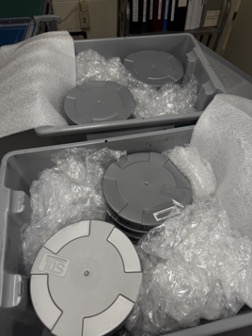 Unpacking various 16mm films post vendor digitization
A Final Reflection
My experience at the Rockefeller Archive Center was extremely rewarding. The opportunity to work alongside Brent, the audiovisual archivist at RAC, who solely manages a large and diverse collection of materials on a day-to-day basis was invaluable. Through this experience, I gained unparalleled insight into the work of an audiovisual archivist at an institution where audiovisual materials are one of many important types of collections. During this Fellowship, I also began my MSLIS program, and I have found that I am able to connect my experience at the RAC to class discussions and assignments almost every week. I would also like to thank the kind and professional staff at the RAC in other departments for taking time out of their busy schedules to meet with me and share their expertise and workflows. I know that wherever I end up next, I will always draw on the skills I learned from the talented staff at the RAC.